Gardena, CA · Now enrolling

Before the doctor walks in,
you've already done the work.

Vitals, injections, blood draws, EKGs, sterile technique. This is the clinical side of medical assisting — no billing, no coding, just the hands-on work. Lecture is online Monday through Thursday, and Friday you're on campus with your hands on the equipment.

440 hours · about 5 months $4,750 — everything included Hybrid — online lecture, Friday labs NHA CCMA exam preparation

No obligation. An advisor follows up — usually within one business day.

Get the program details

Start dates, the payment plan, and how the Friday labs and externship fit around the job you already have.

Your information goes straight to MHCC admissions

The role

What a Clinical Medical Assistant actually does

You're the one the patient sees first and spends the most time with. By the time the provider walks into the room, the vitals are taken, the history is documented, and the patient is ready. That's a clinical role, not a front-desk one.

Do the clinical work

Vital signs, injections, venipuncture, EKGs, wound care, sterile technique, assisting with in-office procedures. These are hands-on skills with a right way and a wrong way, and you'll be graded on doing them correctly.

Know what the numbers mean

A blood pressure of 178/104 isn't a number you write down and move on from. Learning which readings need to be escalated — and how quickly — is what separates a trained assistant from someone following a checklist.

Steady the patient

People arrive nervous, in pain, or embarrassed. Explaining what you're about to do in plain language is part of the skill — and it's the part that makes patients ask for you by name.

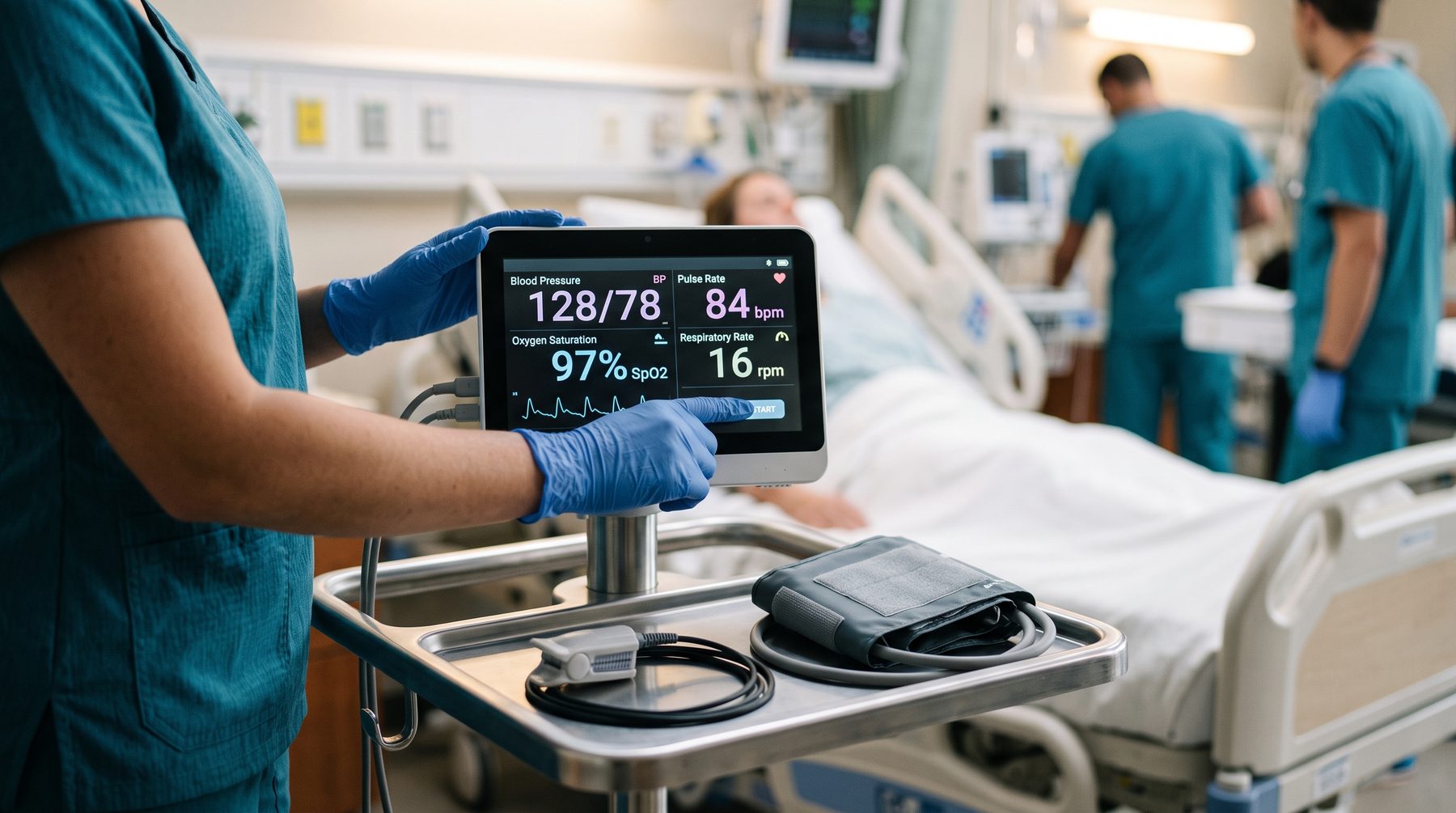
A vital signs monitor displaying blood pressure, pulse, and oxygen saturation readings during a patient assessment.
Taking the reading is the easy part — knowing what it means is the training
A medical assistant in teal scrubs taking a seated patient's blood pressure with a cuff and stethoscope. Vital signs assessment
The training

Lecture online.
Hands on every Friday.

The structure exists for one reason: so you don't have to quit your job to do this. Lecture happens online Monday through Thursday. Fridays you're on campus in the clinical classroom, working on real equipment in a class small enough that the instructor watches your technique and corrects it on the spot. Then an 80-hour externship in a working clinical setting.

  • Vital signs — measurement, documentation, and when to escalate
  • Patient rooming, history intake, and chart preparation
  • Venipuncture and specimen collection
  • Injection technique and medication administration under supervision
  • 12-lead EKG placement and recording
  • Sterile technique, infection control, wound care, and dressing changes
  • Assisting with in-office examinations and minor procedures
  • Clinical documentation and HIPAA standards
  • An 80-hour supervised clinical externship
  • Structured preparation for the NHA Certified Clinical Medical Assistant (CCMA) exam
How the week works

Built around a life you already have

Five months, three parts. Here's what the shape of it actually looks like.

Monday – Thursday

Lecture, online

Anatomy, physiology, medical terminology, pharmacology basics, and the clinical theory behind every skill you'll perform on Friday. You're at a screen, not on campus.

Friday

Hands-on lab, Gardena

The whole point. Exam tables, blood draw chairs, an EKG machine, an autoclave, real clinical equipment — and an instructor close enough to see what your hands are doing.

After class ends

80-hour externship

Supervised clinical hours in a working healthcare setting, so you finish having already done the job — not just studied it. MHCC places you at an approved externship site.

Why MHCC

Not a mill. Not a warehouse.
An actual education.

01 · Class size

Small on purpose

We cap our clinical classes deliberately. You get repetitions and corrections in real time — not a seat in the back of a lecture hall waiting for a turn that never comes.

02 · Equipment

Real clinical gear

Our Gardena clinical classroom is built out with exam tables, blood draw chairs, an EKG machine, an autoclave, an AED, and full clinical training equipment. You practice on the real thing.

03 · Instructors

People who've done the work

MHCC instructors come from the floor, not just the classroom. They teach the version of the job that exists in an actual clinic, including the parts nobody puts in a textbook.

04 · After you finish

Externship and Career Services

Your externship site is arranged for you. Our Career Services department also works with you on your resume, interview preparation, and job search. Employment is never guaranteed — but you don't do the search alone.

Who this is for

If any of this sounds familiar, you're in the right place.

Most of our students weren't in healthcare a year ago. They were closing shifts, answering phones, and waiting for a schedule to get posted.

A medical assistant in teal scrubs with a stethoscope standing in a hospital corridor.
Program at a glance

The practical details

Program length
440 clock hours · about 5 months 360 hours of instruction plus an 80-hour clinical externship.
Tuition
$4,750 — registration, books, uniform, equipment, and exam included $250 registration fee to start. The remaining $4,500 can be paid over time on a no-interest payment plan.
Format
Hybrid — online lecture Monday through Thursday, hands-on lab on Fridays On-campus training at 555 W. Redondo Beach Blvd., Ste. 108, Gardena, CA 90248
Externship
80 supervised clinical hours after classroom instruction MHCC arranges your externship site placement.
To enroll
No high school diploma or GED required A diploma or GED is required by the NHA to sit for the CCMA certification exam.
Credential earned
MHCC Certificate of Completion
Certification exam
Prepares you to sit for the NHA Certified Clinical Medical Assistant (CCMA) exam Certification is awarded by the National Healthcareer Association, not by MHCC.
Enrollment status
Currently enrolling for the next cohort
Straight answers

Questions people actually ask

Am I too old for this?

No. MHCC programs are built for working adults, and most of our students are in their twenties and thirties, coming from retail, food service, or administrative work. You will not be the oldest person in the room.

How long is the program and what does it cost?

440 clock hours — about five months — made up of 360 hours of instruction and an 80-hour clinical externship. Tuition is $4,750, and that number is everything: registration, books, uniform, equipment, and your exam. You pay a $250 registration fee to start, and the remaining $4,500 can be spread out over time on a no-interest payment plan. Ask your admissions advisor what the monthly number would look like for you.

Can I keep working while I do this?

That's exactly what the schedule is built for. Lecture is online Monday through Thursday and the hands-on portion is on Fridays at our Gardena campus. The externship comes after classroom instruction finishes. Tell your admissions advisor what your work week looks like and they'll be straight with you about whether the upcoming cohort fits it.

Do I need a high school diploma or GED?

Not to enroll here — you can start the Clinical Medical Assistant program without one. But you should know the full picture before you commit: the National Healthcareer Association requires a high school diploma or GED to sit for the CCMA certification exam. So you can complete the program and earn your MHCC Certificate of Completion either way, but the certification exam itself will need that diploma or GED. If you don't have one yet, tell your admissions advisor and they'll talk you through the order to do things in.

What's the difference between this and a regular Medical Assistant program?

This one is clinical only. A general medical assisting program splits its hours between clinical skills and administrative work — front office, scheduling, billing and coding. This program spends all of its time on the clinical side: vitals, injections, blood draws, EKGs, sterile technique, assisting with procedures. It's shorter and more focused, and it's the right fit if the hands-on patient work is the part you actually want.

Will I get certified when I finish?

You'll receive an MHCC Certificate of Completion, and the program prepares you to sit for the NHA Certified Clinical Medical Assistant (CCMA) exam. That certification is issued by the National Healthcareer Association after you pass their exam — it isn't awarded by the school. We'll also be straight with you about the job search: our Career Services department works with you on your resume, interview preparation, and applications, but employment is never guaranteed.
Next cohort

The class fills before the ad stops running.

Seats are limited by design — that's the whole point of how we train. Get your details in now and an advisor will tell you exactly where the next cohort stands.

Gardena, CAMontes HealthCare College
Request program info Call